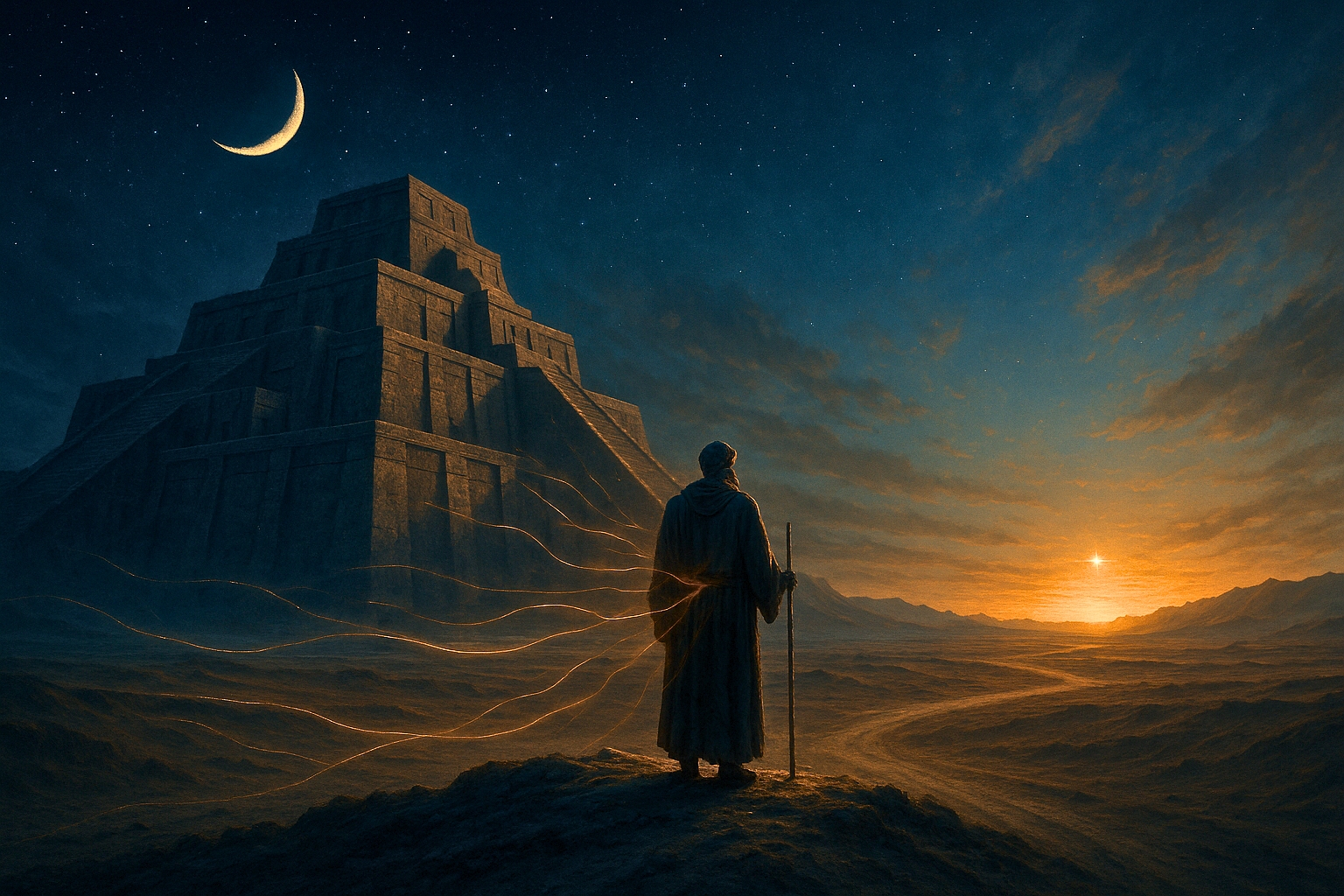
What if our history has a ghost? A traumatic memory, a global cataclysm so profound that it shaped the very dawn of civilization, yet so deeply buried we are only now beginning to recognize its shadow. What if the oldest temple in the world isn’t a place of worship, but a memorial? A library built of stone, its books carved with celestial maps, telling the story of a day the sky fell.
This isn’t a flight of fancy. This is the question that hangs in the air at Göbekli Tepe, a windswept hilltop in southeastern Turkey. Standing there is like looking into the eyes of an ancient storyteller, one who whispers secrets from a time we thought was lost to myth.
“This place shouldn’t exist. According to the story we’ve always told ourselves, humans of this era—some 12,000 years ago—were simple hunter-gatherers, living in small, nomadic bands.”
They hadn’t yet developed agriculture, pottery, or metallurgy. They certainly, we believed, couldn’t have organized the labor, engineering, and abstract thought required to build a monument on this scale.
And yet, here it is.
A Forest of Impossible Stone: The Enigma of Göbekli Tepe
To call Göbekli Tepe a “site” feels inadequate. It’s more like a fossilized dream. Emerging from the earth are circles of monolithic pillars, elegant and haunting. These are the famous T-shaped pillars, carved from single blocks of limestone. They are enormous. Many stand over 18 feet tall and weigh upwards of 10 to 20 tons. In a nearby quarry, an unfinished giant lies waiting, a behemoth weighing a staggering 50 tons. Imagine the effort. Imagine the coordination. How did people, armed with nothing more than stone tools, carve, transport, and erect these giants?
To date, archaeologists have unearthed more than 200 of these pillars in about 20 different enclosures. But the real surprise lies beneath the surface. Geophysical surveys suggest that at least 16 more enclosures remain buried, which could mean hundreds, perhaps thousands, of additional pillars are still waiting to be read. It’s as if we’ve found the first few shelves of a vast, forgotten library.
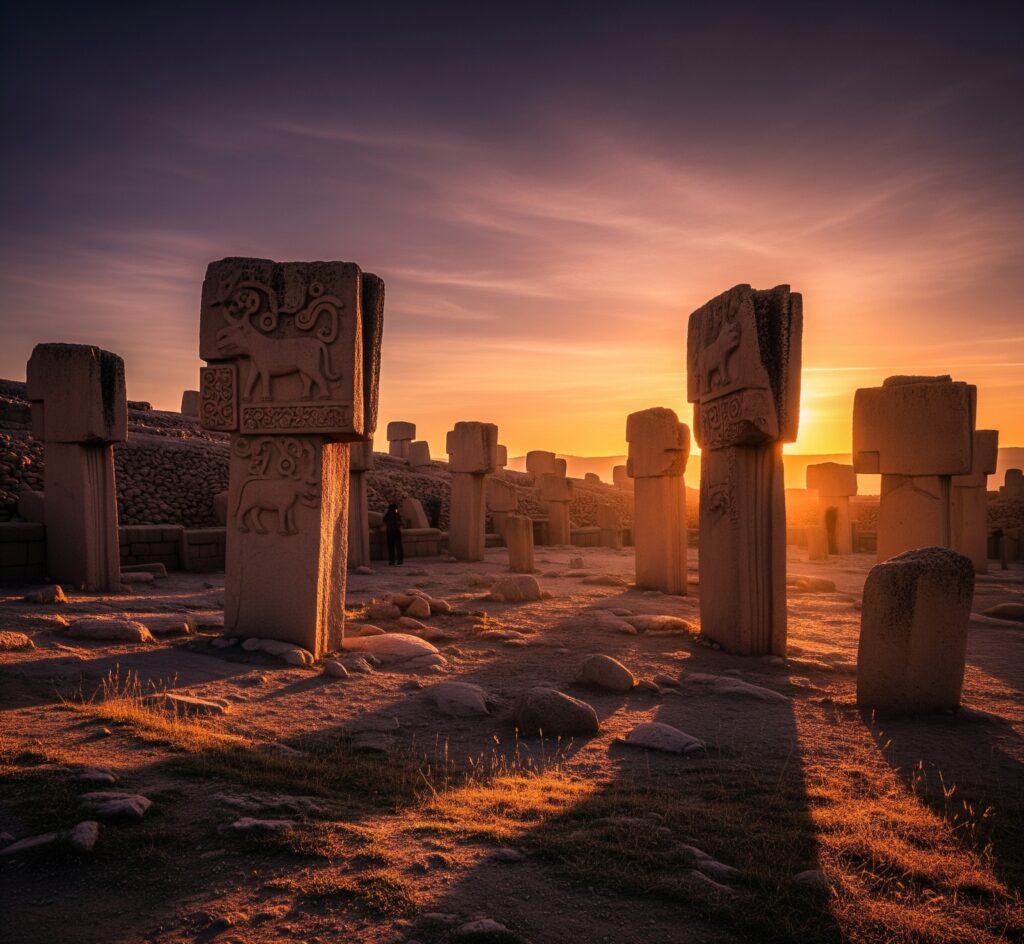
An artist’s depiction of the monumental T-shaped pillars of Göbekli Tepe in Turkey silhouetted against a dramatic sunrise
These pillars are not blank slates. Their surfaces are alive with a menagerie of exquisitely carved reliefs. We see foxes slinking, boars charging, cranes in flight, and scorpions poised to strike. There are long, winding snakes, powerful bulls, and perhaps most enigmatically, vultures. For decades, we looked at these as beautiful examples of prehistoric art, symbols of the natural world these people inhabited.
But what if they are more than that? What if we were looking at the pictures but missing the language?
The Vulture Stone: A Star Map of the Night Sky?
Learning to Read the Sky
To understand the deeper secret of Göbekli Tepe, we first need to look up at the night sky. We see constellations—familiar shapes like Orion or the Big Dipper that we connect into patterns. The official constellations are just one set of patterns. Throughout history, different cultures have connected the stars in their own unique ways, creating pictures that held meaning for them. These culture-specific star patterns are called asterisms.
A groundbreaking paper published in 2017 by researchers Martin Sweatman and Dimitrios Tsikritsis proposed a radical new interpretation.
“They suggested that the animals carved onto the pillars at Göbekli Tepe are not just pictures of earthly creatures. They are asterisms. They are a star map.”
This theory transforms the site from a gallery of wildlife into a sophisticated astronomical observatory, a record of the heavens as they appeared 12,000 years ago. The key to unlocking this map is one of the most famous pillars at the site, known as Pillar 43, or the “Vulture Stone.”
On this pillar, we see a scorpion, a vulture, and other symbols arranged in a specific composition. Sweatman and Tsikritsis argue this isn’t random.
- The scorpion corresponds perfectly with the constellation Scorpius.
- The vulture or eagle is a common symbol for the constellation Sagittarius.
- Other symbols on the stone seem to correspond to Libra and Pisces.
This isn’t just a loose association. Using computer software to model the prehistoric night sky, the researchers wound back the clock, accounting for the slow wobble of the Earth’s axis known as precession. They were looking for a time when these constellations would have appeared in the sky in the exact arrangement depicted on the stone.
They found a date. A startlingly specific one: 10,950 BC.
The Echo of a Cosmic Catastrophe: The Younger Dryas Impact Hypothesis
That date, 10,950 BC, is explosive. Why? Because it aligns almost perfectly with the proposed date for a cataclysmic event that plunged the world into a mini-ice age. This period is known as the Younger Dryas. After millennia of post-ice-age warming, the Earth’s climate suddenly and violently snapped back into frigid conditions, a change that lasted for over 1,200 years.
The leading theory for this sudden freeze is the Younger Dryas impact hypothesis. It posits that a fragmented comet, or multiple comets, slammed into the Earth or exploded in the atmosphere, triggering widespread wildfires, darkening the sky with dust, and causing the vast North American ice sheets to melt. This influx of freshwater shut down the ocean currents that regulated global temperature, leading to the dramatic cooling.
Pillar 43 may be a direct account of this event.
The circle held by the vulture could represent the sun. The various animal asterisms show the location in the sky where the event occurred. And crucially, there is another figure on the stone: a headless man. This, the researchers suggest, is a powerful and universal symbol for death, disaster, and the loss of life on a massive scale.
“Göbekli Tepe, then, becomes a memorial to this world-altering cataclysm. The people who built it were not just remembering a bad winter; they were commemorating an event that shattered their world.”
This interpretation also sheds light on the most common animal carving at the site: the snake. Snakes are everywhere. While they could represent an earthly threat, in the context of a cosmic event, they take on a new meaning. Sweatman and Tsikritsis propose that the snakes represent the Taurid meteor stream—the very debris field from which the cataclysmic comet is thought to have originated. Even today, our planet passes through this stream twice a year, producing meteor showers. To the survivors, this recurring shower would have been a terrifying and sacred reminder of the source of their destruction.
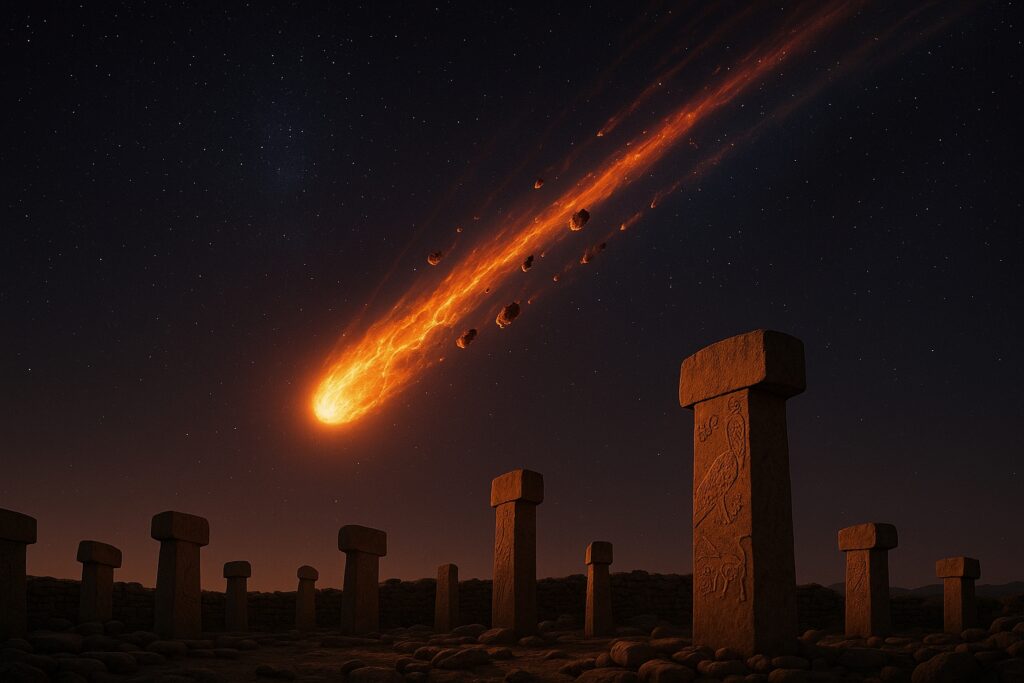
A symbolic depiction of a comet event in the sky above the ancient pillars of Göbekli Tepe
A Sanctuary for Survivors: Rebuilding After the Cataclysm
Here is where the story takes its most profound turn. Göbekli Tepe was not built in the immediate, chaotic aftermath of the impact. The construction seems to have begun around 9600 BC, just as the Younger Dryas was ending and the world was beginning to warm again.
Imagine what this means. For over a thousand years, the survivors and their descendants held onto the memory of the catastrophe. They passed the story down through generations, a sacred narrative of the time the sky burned and the sun vanished. When the climate finally stabilized, they came together on this hill. They pooled their resources, their labor, and their collective memory, and they built this monument.
It was an act of paying homage to the event that nearly destroyed them. It was a school, a place to teach the next generation about the awesome and destructive power of the cosmos. It was a way to codify the “date” of the disaster so it would never be forgotten.
“The entire purpose of Göbekli Tepe may have been to serve as a permanent record, ensuring that humanity would remember to watch the skies.”
This wasn’t just a place of grim remembrance, however. It was a place of life. Archaeologists have found evidence of massive feasts. They’ve unearthed tens of thousands of grinding tools—mortars, pestles, and grinding slabs used to process wild cereals. They’ve found enormous stone vessels that could have held over 40 gallons of liquid, possibly for brewing a simple form of beer.
This was a ritual center, a gathering place. People traveled from miles around to participate in the work, to share in the feasts, and to take part in the ceremonies that reconnected them to this pivotal moment in their history. In the shadow of their greatest trauma, they forged a new, more complex society.
A Message Sealed in Time: The Purpose of Göbekli Tepe
Then, around 8000 BC, after more than 1,500 years of use, the people of Göbekli Tepe did something extraordinary. They buried it. They deliberately and carefully covered the entire complex with millions of cubic feet of earth, entombing their stone library and preserving it for the future.
Why? We can only speculate. Perhaps its purpose was served. Perhaps the memory was so painful they chose to seal it away. Or perhaps, in an act of incredible foresight, they were creating a time capsule, knowing that a future humanity would one day have the tools to unearth it and read its message.
Göbekli Tepe is more than a collection of stones. It is a testament to human resilience.
“It shows us that our ancestors were not the simple primitives we imagined. They were keen observers of the sky, brilliant engineers, and the keepers of a profound, traumatic memory.”
They witnessed a world-changing event and found a way not only to survive it but to create something of breathtaking meaning and complexity in its wake.
They are reaching out to us across 12,000 years, reminding us that we are the inheritors of their legacy. They are asking us to look up, to remember, and to listen to the whispers of the megaliths. Their story, it turns out, is our own.
Join The Project
The inquiry doesn't end with this article. Our weekly newsletter is where The Project continues. Each week, we deliver new findings—from deconstructing ancient history to forging philosophical thought experiments. It's our expedition into the source code of the human story, delivered directly to your inbox.

We are JD Lemky. He’s a physical chemist trained in academic rigor; she’s an editor with degrees in both literature and biochemistry. We use a scientist’s skepticism and a storyteller’s eye to challenge the official history, exploring the echoes of lost worlds to find what they can teach us about our own.