What if the first time a human being recorded a complete thought, it wasn’t written, but preserved? Imagine an idea so profound it was captured in clay, leaving behind an impression not of ink, but of pure intellect. What if, scattered across the river valleys of ancient Europe, lie the fossilized thoughts of a lost civilization? This isn’t a fantasy. It’s the reality posed by a collection of enigmatic etchings that challenge the very timeline of human history: the Vinča symbols. These strange, geometric imprints, found on artifacts from a forgotten world, could represent the oldest writing on the planet. They are a whisper from the past, the intellectual DNA of the Danube Valley Civilization, and they force us to excavate the very foundations of what we believe about our own story.
What was the Vinča culture?
Before we can analyze the fossils, we must first understand the world that gave them life. The Vinča culture, also known as the Danube Valley Civilization, thrived in what is now Serbia, Romania, Bulgaria, and the surrounding Balkan region between roughly 5700 and 4500 BC. To truly grasp their significance, we must see them not as a people slowly “emerging from the Stone Age,” but as a sophisticated society that blossomed in the world that came after a period of global upheaval following the Younger Dryas. This was not a primitive beginning; this was a renaissance.
“The Vinča were anything but simple.”
From the dust of millennia, we are reconstructing the image of a brilliant society. They built some of the oldest communities with permanent dwellings we have discovered in Europe since that cataclysmic period. These were not crude villages, but organized towns that grew into sprawling metropolises—some of the largest known on the continent for their time. They were master artisans, and the artifacts they left behind are clues to a rich inner world, from exquisitely crafted pottery to hauntingly beautiful anthropomorphic figurines. They were also pioneering metallurgists, demonstrating a mastery of copper smelting at a shockingly early date.
This was an ecosystem of profound complexity, held together by far-reaching trade and deep ritual. It is from this rich cultural soil that the mysterious Old European script emerged. The people of the Danube Valley weren’t just surviving; they were expressing a complex worldview. And they found a way to make their ideas permanent.
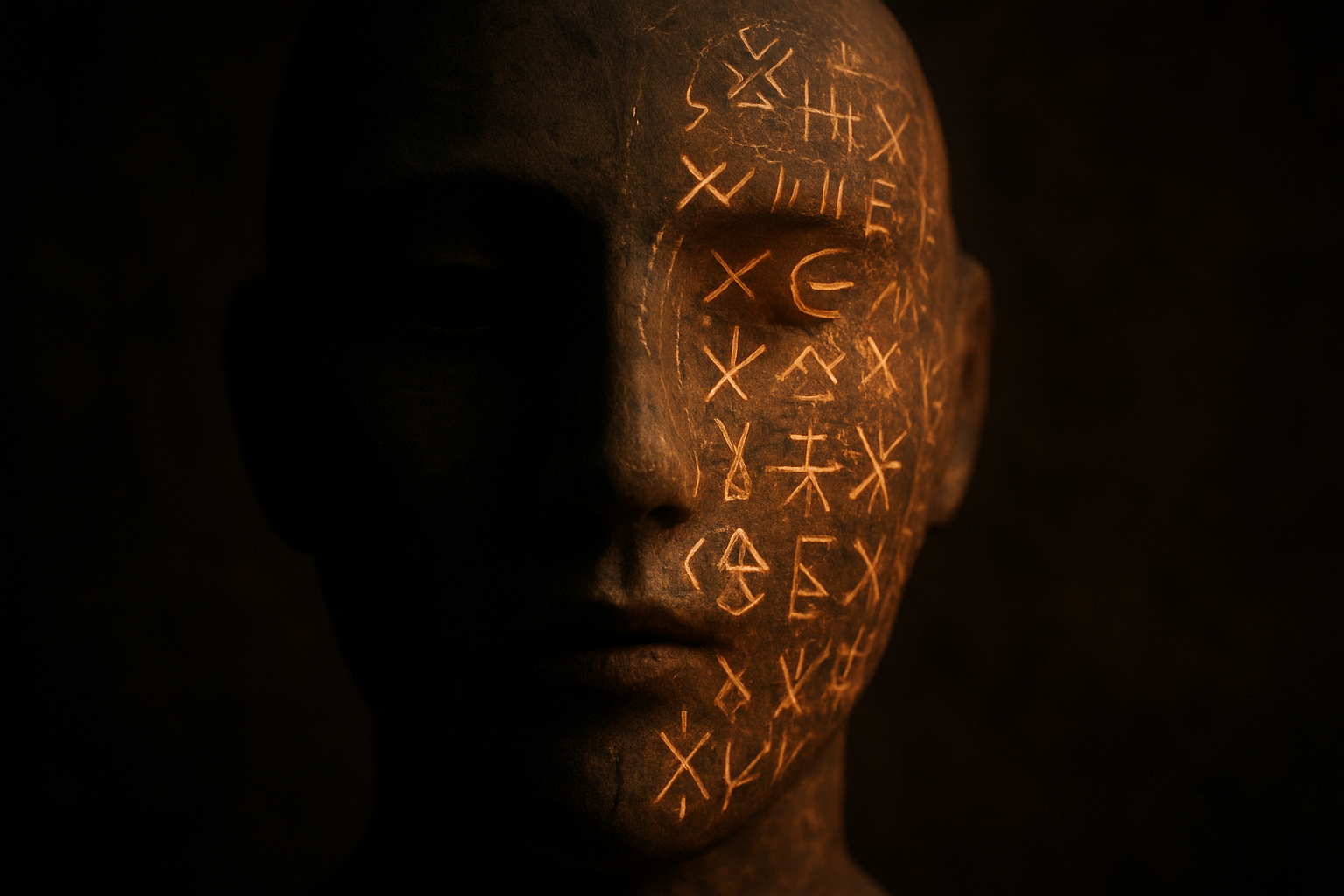
A clay figurine from the Danube Valley Civilization, with ancient Vinča symbols carved into its surface.
What do the Vinča symbols mean?
Here, we become paleontologists of the mind, carefully brushing away the dust from these impressions to see the shape of the ideas they once held. The symbols, over 700 of them in total, are found carefully inscribed on pottery, figurines, and mysterious tablets. Are they simple ownership marks? Or are we looking at the skeletal remains of a forgotten language?
The most cautious interpretation labels them “proto-writing.” This suggests a symbolic system that conveys information but lacks the full grammar of a spoken language. It is a system of meaning, but not necessarily of speech.
But a more thrilling possibility is being excavated. A growing body of research suggests we are not just looking at simple Neolithic symbols, but at the imprints of a stunningly complex astronomical understanding. Could these ancient people have been capturing the cosmos in clay? The research presented by a team from the Romanian Academy’s Astronomical Institute, for example, paints a picture of a civilization deeply connected to the stars. They see the Danube Valley Civilization script as a language not of earthly goods, but of cosmic order.
Let’s look at the evidence they present. An artifact known as “The black spindle from Turdaș” is re-framed as a “celestial cult yearbook.” Its intricate patterns are interpreted as star charts marking the sky around the autumnal and spring equinoxes.
“This wasn’t just decoration; it was a functional tool for tracking the heavens.”
Even more astonishing is the “Spondylus shell from Mostonga,” which is analyzed as an “engraved celestial map.” The researchers identify specific constellations carved into its surface—the Perseus family, Ursa Major, the Orion family, and Hercules. The idea that a Neolithic artisan was carving recognizable star patterns into a shell over 7,000 years ago is breathtaking.
Perhaps most famously, this astronomical lens gives new meaning to the Tărtăria tablets. They are seen as a form of “astronomical calendar.” The analysis suggests the symbols mark key solar events, noting that during the Neolithic period of the agrarian society from Tărtăria, “the vernal equinox was between Gemini and Cancer constellations, and the autumnal equinox was between Capricornus-Aquarius and Sagittarius-Scorpius stars patterns.” This is not the work of a primitive culture; this is the work of meticulous observers. The evidence even extends to their architecture, with the Parța Neolithic shrine being identified as a religious observatory where sunlight would strategically illuminate the interior through openings in the walls, marking the changing seasons.
If this interpretation is correct, then we are looking at something profound. We are seeing the fossilized thoughts of Neolithic astronomers, of people who possessed a deep, functional knowledge of the cosmos and found a symbolic language to record it.
Is the Vinca script older than Sumerian cuneiform?
Here, the timeline becomes a geological shock. We are digging into a layer of history so deep it should not exist. The oldest artifacts bearing Vinča symbols have been dated as far back as 5300 BC. In comparison, Sumerian cuneiform, long hailed as the dawn of writing, appears around 3400-3100 BC.
“That is a chasm of nearly two thousand years.”
If these symbols are a true writing system, it is like finding a complex fossil in a layer of rock where only single-celled organisms were thought to exist. It shatters our timeline of intellectual evolution. It means that the technology of recorded thought was not born in Mesopotamia, but in an ancient European culture whose brilliance we are only now beginning to exhume.
This discovery rewrites our entire origin story. The very idea of a single “cradle of civilization” crumbles, replaced by a vision of a past with multiple peaks of stunning achievement. It presents us with the long shadow of a lost chapter of human history, a European “Old Kingdom” whose intellectual fire was so bright it left behind these indelible marks, these permanent echoes in clay.

The Tărtăria tablets, a key artifact of the Vinča script, potentially representing the oldest writing in the world.
Has the Danube script been deciphered?
Despite this intellectual excavation, the thoughts themselves remain locked in stone. The Danube script is undeciphered. The mind that created these impressions is silent, and we have not yet found a way to make it speak again. The challenges are immense, and they are best understood by looking at the most famous decipherment in history: the Rosetta Stone.
The Rosetta Stone was the key that unlocked Egyptian hieroglyphs because it was a multilingual decree. It contained the same text carved in three scripts: formal hieroglyphs, everyday Demotic script, and, crucially, Ancient Greek. Since scholars in the 19th century could read Ancient Greek, they had a bridge. They could match the Greek words to the unknown hieroglyphs, slowly building a dictionary and grammar for a language that had been silent for centuries.
For the Vinča symbols, we have no such bridge. There is no Vinča Rosetta Stone. We have no parallel text, no known language to compare it to.
“We are staring at a library written in a language no one has spoken for seven millennia.”
Furthermore, the inscriptions are agonizingly brief. Most are just a handful of symbols on a single artifact. It’s as if we found a single, fossilized word without the connective tissue of a sentence. Without longer texts, linguists cannot spot the recurring patterns and grammatical rules that are the lifeblood of a living language. We may have the bones, but we cannot reconstruct the animal.
The immense age means that any language they represent has turned to dust, leaving no descendants. It is an orphaned language, an intellectual lineage with no living descendants. The voice has been utterly lost to time, and only its beautiful, silent imprint remains.
A Message Across Millennia
To gaze upon a Vinča symbol is to come face-to-face with a 7,000-year-old thought. The living, breathing idea is gone, the mind that conceived it has vanished, but its shape—its very structure—has been preserved for us to witness.
Whether they are the oldest writing in the world, a cosmic blueprint, or a sacred language whose meaning is forever lost to us, the Vinča symbols change our relationship with the deep past. They are the undeniable proof of a brilliant and complex “Old Europe” that was a cradle of innovation in its own right. They are the evidence that history is not a simple line, but a vast and fractured landscape, littered with the ruins of a forgotten past.
The people of the Danube Valley Civilization are gone. But they found a way to make their minds immortal. They left us their thoughts, petrified in clay—a question, an observation, a prayer—waiting for a future that might, one day, learn to hear the silence.
Join The Project
The inquiry doesn't end with this article. Our weekly newsletter is where The Project continues. Each week, we deliver new findings—from deconstructing ancient history to forging philosophical thought experiments. It's our expedition into the source code of the human story, delivered directly to your inbox.

We are JD Lemky. He’s a physical chemist trained in academic rigor; she’s an editor with degrees in both literature and biochemistry. We use a scientist’s skepticism and a storyteller’s eye to challenge the official history, exploring the echoes of lost worlds to find what they can teach us about our own.