The Drowned Memory: Pulling on the Thread of a Global Flood
What if the stories our most ancient ancestors told—the tales of a great flood that consumed the world—weren’t just myths? What if they were memories?
It’s a thought I often return to on this journey. We are a species with a strange and persistent collection of tales about an all-encompassing deluge. From the Epic of Gilgamesh to the story of Noah, from the Hindu tales of Manu to the folklore of indigenous peoples across the Americas, the narrative is startlingly consistent: the waters rose, and the world that was, was no more.
These stories suggest a profound, collective trauma—a slate wiped clean by a global catastrophe. If that’s true, it means our official histories, which chart a steady, linear march of progress, might be missing their entire first chapter. This leads us to the essential question, the one that drives our entire journey: If a sophisticated civilization existed and was then erased by the rising seas at the end of the last Ice Age, where would we find its remains?
“The answer is as simple as it is profound. The evidence isn’t buried in sand, but is sleeping under the pressure of the abyss.”
Let’s pull on this thread together and see where it leads, starting with a tantalizing clue from the Younger Dryas period, a time of catastrophic climate change. You can read more about this very unusual time in our article about Gobekli Tepe.
Our first stop on this underwater journey is a mysterious stone path lying in the shallow waters of the Bahamas.
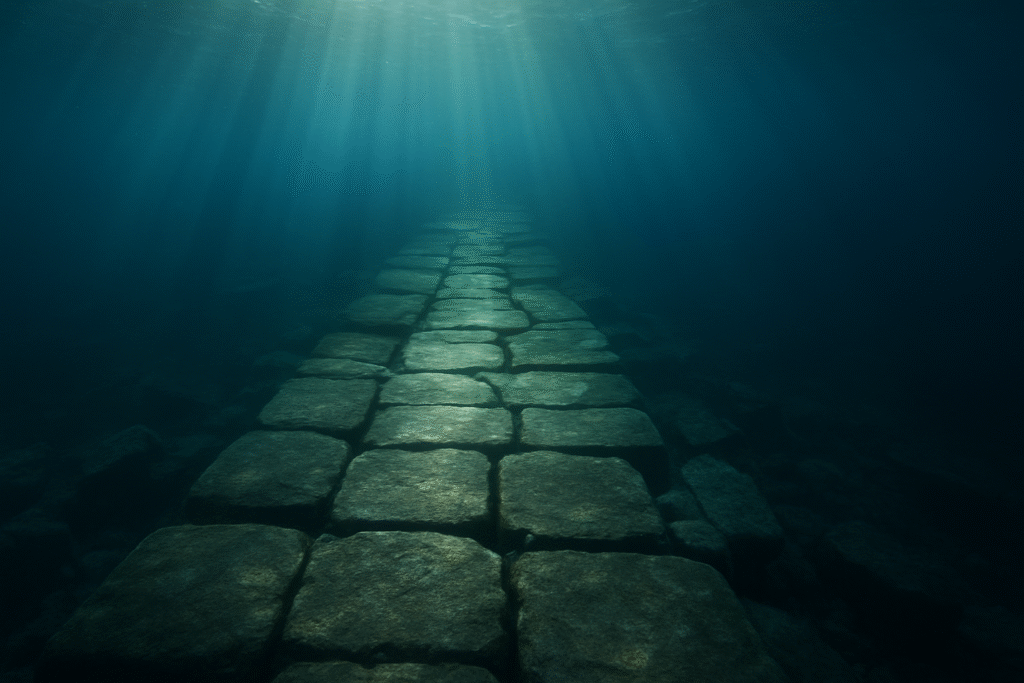
The mysterious Bimini Road, one of many potential lost underwater cities that challenge our understanding of ancient history.
The Bimini Road: A Pathway to a Lost World or a Trick of Nature?
Off the coast of the island of Bimini lies one of the most debated underwater anomalies on the planet: a submerged formation known as the Bimini Road. It’s an orderly arrangement of massive, rectangular limestone blocks, forming a J-shaped structure that stretches for nearly half a mile. To swim over it is to feel an undeniable sense of human design.
The official geological explanation is simple and, on the surface, quite compelling. Geologists propose that what we’re seeing is naturally fractured beach rock. They argue that as sediment cemented into limestone, the unique pressures and stresses of the coastal environment caused it to break in these remarkably straight lines and near-perfect right angles.
And we must give this theory its due respect.
“Nature is full of wonders that mimic intelligent design. But the deeper you look at the Bimini Road, the more the simple explanation begins to fray.”
Divers and independent researchers have pointed out features that defy this naturalistic origin. Some blocks appear to be propped up by smaller stones, almost like foundational supports. Others seem to be arranged in two distinct layers, something not seen in natural beach rock formations. Most compelling are the reports of what appear to be tool marks and the presence of blocks made from a material not native to the immediate area.
The question of the Bimini Road explained is not a simple binary of “natural vs. man-made.” Instead, I believe we should be asking a better question: Does this feature, when viewed in context with other anomalies around the world, form a pattern? It is a piece of a much larger puzzle, and to understand it, we must journey from a place of tantalizing mystery to one of undeniable, tragic memory.
Doggerland: What Happens When a Civilization Vanishes Beneath the Waves?
Unlike the Bimini Road, Doggerland is not a theory. It is a geological and archaeological fact.
Imagine, if you will, a time around 8,000 BCE. The great ice sheets that once covered much of Europe are in their final retreat. Between what we now call Great Britain and continental Europe lies not the cold, choppy North Sea, but a vast, low-lying plain teeming with life. This was Doggerland.
It was a heartland of ancient Europe, a sprawling landscape of rolling hills, marshlands, and dense forests. This vibrant world was home to people—a place where families lived, children played, and a whole chapter of the human story unfolded. Its rivers snaked across the landscape, flowing into a great freshwater lake at its center. This wasn’t a sparse, barely-inhabited wasteland; it was a home.
But their world was living on borrowed time. The melting ice caps were releasing unfathomable volumes of water into the oceans.
“The Younger Dryas sea level rise was not a gentle lapping at the shore; it was a relentless, generational catastrophe.”
Land that had been known for hunting for time immemorial would have become treacherous marshland within a single lifetime. Generation by generation, the sea advanced. Coastlines vanished. What was once a vast, contiguous plain fractured into a mosaic of ever-shrinking islands, isolating communities and turning neighbors into strangers across impassable channels. Eventually, the last high points, the final refuges for a people who had known no other home, slipped beneath the waves. There was no single, dramatic end—only the slow, inexorable victory of the ocean.
Doggerland is our anchor in this deep mystery—the confirmed story of a world lost to the waves. It demonstrates, without any doubt, that huge, populated landmasses can disappear beneath the waves, taking all direct evidence of their inhabitants with them. If we can lose an entire human world so completely, what of ancient submerged cities belonging to a culture we don’t even know existed?
The Gulf of Khambhat: Does the Myth of Dwarka Point to a 9,500-Year-Old Truth?
Our journey now takes us to the coast of India, to a discovery that could rewrite the history of civilization as we know it. In 2001, India’s National Institute of Ocean Technology was conducting a routine survey of the Gulf of Khambhat when their side-scan sonar made an impossible finding.
Nine miles from shore, at a depth of 130 feet, their screens displayed the unmistakable signatures of immense, geometric structures. These weren’t random geological formations; they were clearly defined, stretching for miles in a grid-like pattern, reminiscent of a large, planned city.
Subsequent dredging operations brought up artifacts that only deepened the mystery. They found construction material, pottery, sections of fossilized wood, and even human remains.
“The astonishing part? When the wood was carbon-dated, it returned an age of 9,500 years, or 7500 BCE.”
This single data point quietly shatters the established timeline of civilization, placing a major city in an era history tells us should have had none.
This is where science and myth begin to converge in a breathtaking way. Hindu tradition is filled with stories of Lord Krishna and his magnificent city, Dwarka, which was said to have been built on land reclaimed from the sea. The scriptures state that after Krishna’s death, the sea rose up and reclaimed his city, swallowing it in a single day. Is Dwarka real? For centuries, it was considered a myth.
But here, in the Gulf of Khambhat, we have an ancient Indian city underwater, dated to the very period when the post-Ice Age seas were rising dramatically. Is this the historical lost city of Dwarka? Is the ancient myth a vessel carrying the memory of this real, cataclysmic event? The data from the sonar and the dates from the artifacts suggest that the answer might be yes.
An artist’s interpretation of the lost city of Dwarka in the Gulf of Khambhat, an underwater discovery that could be evidence of a forgotten civilization.
The Cuban Pyramids: An Impossible Discovery in the Abyssal Plain?
If our previous stops have been pulling on the thread, this is where the entire fabric of consensus history begins to unravel. In the year 2000, a Canadian company run by Pauline Zalitzki and her husband Paul Weinzweig was mapping the ocean floor in the deep waters off the western tip of Cuba. What their sonar found was beyond comprehension.
At a staggering depth of over 2,200 feet, their equipment mapped a series of symmetrical, pyramid-like structures, arranged in a geometric pattern on the smooth, sandy floor of the abyssal plain. The images showed crisp, clean lines, formations that looked utterly artificial, resembling a vast urban complex. This was the discovery of the so-called Cuban underwater pyramids.
To accept this discovery is to accept that our model of the recent geological past is fundamentally incomplete. For a city to exist at that location, the land it was built on would have had to sink by over 2,000 feet. The slow, gradual sea-level rise we saw with Doggerland cannot account for this. Not even close.
“For this underwater city off Cuba to be real, the mechanism of its sinking must have been something far more violent, far more terrifying.”
This is why mainstream science has largely dismissed the discovery. There has been little to no follow-up investigation. The official position is that such a subsidence is geologically impossible in that time frame. And within the standard model of history and geology, they are correct.
But what if the model is wrong? What if the end of the Younger Dryas wasn’t just about melting glaciers? What if the evidence of cataclysm points to something far greater—a crustal displacement, a massive tectonic shift, an event so violent it could cause entire landmasses to collapse into the sea? It is a radical idea, one that challenges the very foundations of our understanding of Earth’s history. But it is an idea that could explain the impossible depth of these structures.
Drowning in Water, or Dogma? Reframing the Question of Our Past
We have journeyed from the shallows of the Bahamas to the abyssal plains off Cuba. We have seen a scientifically accepted drowned world in Doggerland and a mythically resonant one in the Gulf of Khambhat. Viewed in isolation, each of these lost underwater cities can be explained away—as a natural formation, a local legend, a sonar anomaly.
But when you place them on a map, when you see them not as isolated incidents but as a global pattern of submerged anomalies, the story changes.
“These are not separate mysteries. They are echoes of the same event, ripples from a single, great cataclysm that defined the dawn of our modern era.”
Perhaps the ultimate question isn’t, “Is there one single, incontrovertible artifact that proves a forgotten civilization existed?”
Perhaps the better question is this: “Does the combined weight of the geological, mythological, and archaeological evidence from around the world strongly suggest that the defining event in our collective past is one we have almost entirely forgotten?”
The evidence lies waiting in the deep. The story is there, submerged beneath the waves. The real obstacle to rethinking history may not be the depth of the water, but the rigidity of the dogma that tells us not to look. Our journey is about daring to look, to ask the forbidden questions, and to reclaim the greatest story never told.
Join The Project
The inquiry doesn't end with this article. Our weekly newsletter is where The Project continues. Each week, we deliver new findings—from deconstructing ancient history to forging philosophical thought experiments. It's our expedition into the source code of the human story, delivered directly to your inbox.
We are JD Lemky. He’s a physical chemist trained in academic rigor; she’s an editor with degrees in both literature and biochemistry. We use a scientist’s skepticism and a storyteller’s eye to challenge the official history, exploring the echoes of lost worlds to find what they can teach us about our own.
To provide the best experiences, we use technologies like cookies to store and/or access device information. Consenting to these technologies will allow us to process data such as browsing behavior or unique IDs on this site. Not consenting or withdrawing consent, may adversely affect certain features and functions.
Functional
Always active
The technical storage or access is strictly necessary for the legitimate purpose of enabling the use of a specific service explicitly requested by the subscriber or user, or for the sole purpose of carrying out the transmission of a communication over an electronic communications network.
Preferences
The technical storage or access is necessary for the legitimate purpose of storing preferences that are not requested by the subscriber or user.
Statistics
The technical storage or access that is used exclusively for statistical purposes.The technical storage or access that is used exclusively for anonymous statistical purposes. Without a subpoena, voluntary compliance on the part of your Internet Service Provider, or additional records from a third party, information stored or retrieved for this purpose alone cannot usually be used to identify you.
Marketing
The technical storage or access is required to create user profiles to send advertising, or to track the user on a website or across several websites for similar marketing purposes.