What if the most powerful move a leader can make is not to fight, but to walk away?
It’s a question that feels almost alien in our modern world, a world that celebrates the fighter, the activist, the one who never backs down. We are taught to stand our ground, to win the argument, to vanquish our opponents in the public square. But I find myself wondering, in this relentless pursuit of victory, what do we risk losing? What happens when the only way to win the battle is to burn down the arena itself?
We see it play out every day in the digital ether and the halls of power. A righteous cause becomes a war of attrition, and in our desperation to win, we begin to adopt the very tactics we once decried in our adversaries.
“We justify the means by the nobility of our ends, never pausing to see the corrosion spreading through the foundations of our own beliefs.”
In a culture obsessed with winning, we have forgotten the art of preserving the game.
This is not a new dilemma. It is an ancient human tragedy, a paradox that has confronted leaders since the dawn of civilization. And perhaps no one ever faced it with more clarity, or paid a higher personal price for his choice, than a Roman general who saved his civilization from its greatest enemy, only to discover his true fight lay within its walls. His name was Publius Cornelius Scipio, but history would remember him as Africanus. His story is a profound example in a forgotten ideal: stoic leadership.
The Modern War of Attrition: Why We Win Battles But Lose Ourselves
We all know the feeling. That pull to engage, to correct a wrong, to defend a cherished principle against attack. It begins with a sense of clarity and purpose, a belief that our voice is necessary. But all too often, the debate devolves. The public square becomes a battlefield, and the goal shifts from mutual understanding to unconditional surrender.
The conflict becomes a part of our identity. We are no longer just people who hold a certain belief; we are warriors for that belief. And in war, things are permitted that would be unthinkable in peace.
“We chip away at civility, we sacrifice nuance for the sake of a cutting remark, we even begin to entertain solutions that would ultimately undo the very fabric of the freedom we claim to be defending.”
This is the slow, grinding tragedy of the modern war of attrition. We may win a specific argument, force an opponent to concede, or rally our tribe to a fever pitch, but what is the cost? We become harder, more cynical, and more isolated. We win the battle, but in the process, we lose a piece of ourselves—and we weaken the shared ground upon which any healthy society must stand.
The Arena and the Abyss: What is a Pyrrhic Victory in Politics?
The ancient Greeks had a term for this: a Pyrrhic victory. Named for King Pyrrhus of Epirus, who won a battle against the Romans but lost so many of his best men that he was quoted as saying, “One more such victory and I am undone.” It is a victory that is indistinguishable from a defeat, a triumph that costs you everything.
What, then, is a Pyrrhic victory in politics or public life? It is pushing for a policy that silences your opponents, only to find that the very same tool is later used to silence you.
“It is destroying a person’s reputation to win a debate, only to discover you have fostered a culture where no reputation is safe, including your own.”
It is the act of gaining power by undermining the institutions that grant that power legitimacy. This is the abyss that stares back at every leader, every activist, every person who engages in public life. The temptation is always there: to go one step further than your opponent, to break one more rule, to strike one final, decisive blow. Scipio Africanus stared into this abyss, with the full power to win on its terms. What he did next should echo through the ages.
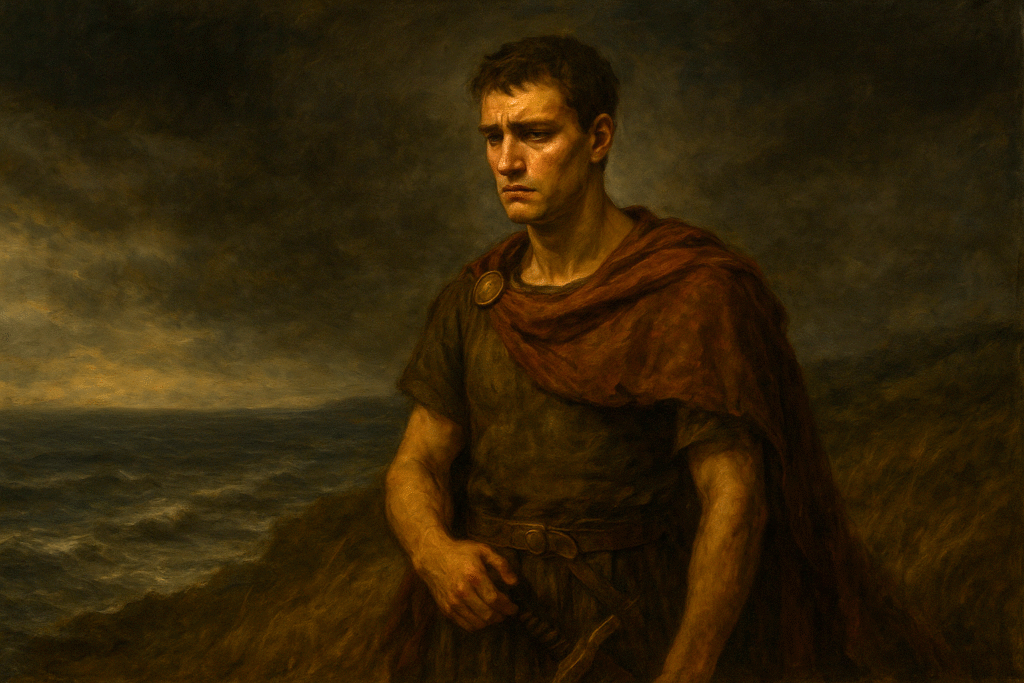
A portrait of a young Scipio Africanus, embodying the determination and internal conflict of stoic leadership.
The Impossible Choice: Who Was Publius Cornelius Scipio?
To understand Scipio’s final, extraordinary act, you must first understand the man. This was not someone who shied away from a fight. Publius Cornelius Scipio was forged in the burning forge of Rome’s darkest hour.
As a teenager, he witnessed the Roman myth of invincibility shatter against the genius of Hannibal Barca. He survived the apocalyptic slaughter at Cannae, a battle that killed a fifth of Rome’s adult male population. Surrounded by the ghosts of the dead, he found a group of high-born officers planning to flee Italy and abandon the Republic. Scipio, in a blaze of furious will, drew his sword and swore an oath to kill any man who would desert Rome. He forced them all to take the same oath, single-handedly holding the soul of the Roman Republic together through sheer, terrifying conviction.
“He was the man who accepted the command in Spain when no one else would, a post that was considered a death sentence.”
There, outnumbered and outmaneuvered, he did not just fight Hannibal’s brothers; he studied his nemesis, deconstructing Hannibal’s tactics of speed and misdirection, and turned them back on the Carthaginians themselves. He captured their capital, New Carthage, in a single, audacious stroke and systematically dismantled their power in battles like Baecula and Ilipa.
He returned to Rome a hero and did what the Senate had feared for over a decade: he took the war to Africa and defeated Hannibal himself at the Battle of Zama, ending a generation of terror. He was not a man who knew how to lose. He was the greatest monster-hunter his people had ever known.
The Unwinnable Fight: Scipio’s True Enemy Wasn’t Hannibal
After Zama, Scipio was more than a general; he was a living god, adored by the people. And in the cold, marble halls of the Senate, this made him more dangerous than Hannibal had ever been. His true enemy was not a foreign invader, but an internal one, embodied by a relentlessly conservative senator: Cato the Elder.
Cato and his faction saw in Scipio’s singular fame and the personal loyalty of his armies the seeds of a monarchy. They feared he would become a king, and they dedicated themselves to tearing him down. They couldn’t attack his victories, so they attacked his virtue.
They brought politically motivated charges of embezzlement against his brother, Lucius, hoping to tarnish the family name. In a moment of legendary defiance, Scipio stood before the Senate, took the accounting books his brother was about to use for his defense, and ripped them to shreds.
“The gesture was a thunderclap of contempt. My honor, it screamed, is not subject to your audit.“
The move was magnificent, but it was politically fatal. It proved to Cato’s faction that Scipio believed he was above the law. They then came for him directly, charging him with treason.
This was the unwinnable fight. Scipio knew he could win. The people of Rome adored him. He had the loyalty of veterans across Italy. He could have easily marched on the city, purged the Senate, and had himself declared ‘dictator for life.’ He could have won the political battle against Cato by becoming the very tyrant Cato accused him of being. He could save his reputation by destroying the Republic he had dedicated his life to protecting.
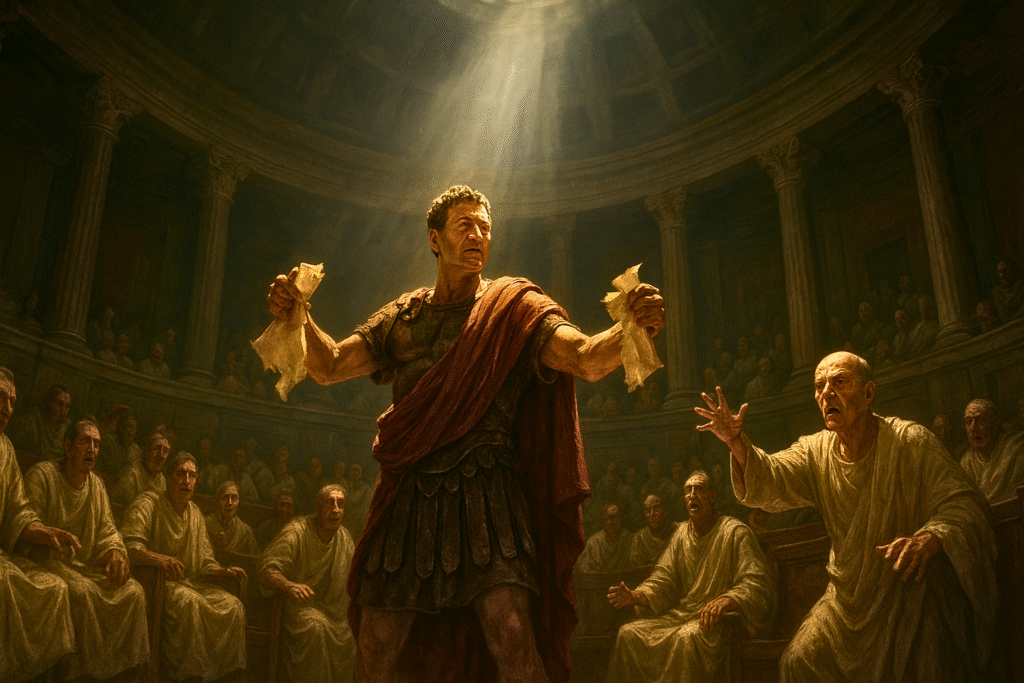
Scipio Africanus defies the Roman Senate and Cato the Elder, choosing personal honor over political maneuvering.
The Citadel of the Self: Retirement as an Act of Stoic Leadership
And here, at the absolute pinnacle of his power and his crisis, Scipio made his impossible choice. On the day of his trial, he walked into the Forum, and instead of offering a defense, he reminded the assembled masses that this was the anniversary of his victory at Zama. He then turned his back on his accusers and walked to the Capitol temple to give thanks to the gods. The entire crowd followed him, leaving the prosecutors alone in an empty square.
He had proven his power. He had won. And then, he let it go.
“Instead of fighting, instead of becoming the monster they claimed he was, he simply left. He retired from public life to his private villa at Liternum, never to set foot in Rome again.”
This was not an act of surrender. It was the ultimate act of stoic leadership.
The Stoic philosophers teach that the wise person differentiates between what they can control and what they cannot. Scipio could not control the jealousy of lesser men. He could not control the political machinations of the Senate. But he could control his own actions. He could refuse to participate in a game that would corrupt him and destroy the state.
He chose to protect the citadel of his own integrity. By walking away, he performed his last, and perhaps greatest, service to the Republic. He demonstrated that true strength lies not in the capacity to dominate others, but in the mastery of oneself. He loved the idea of Rome more than he loved his own power within it.
What Can Scipio’s Sacrifice Teach Modern Leaders?
Scipio’s story feels like a poignant lesson for our own fractured time. It asks us to reconsider our definition of strength. It suggests that there are moments when the most courageous act is to refuse to fight on the enemy’s terms, to de-escalate, to yield the public square in order to preserve its foundations.
What can this teach modern leaders? It teaches that some victories are not worth the cost. It teaches that true leadership is sometimes about absorbing a personal loss for a collective gain. It is the CEO who refrains from a hostile takeover that would enrich him but destabilize an industry. It is the politician who steps back from a divisive campaign that would guarantee his victory but tear the country apart. It is any of us who chooses to log off rather than win a soul-crushing online argument.
“This form of leadership requires an almost superhuman level of self-awareness and control. It is the understanding that the ultimate victory is not about being proven right, but about contributing to a system where truth can eventually flourish.”
Truth is far too often the casualty of man’s contempt.
Scipio’s final act was a silent one, a retreat from the noise and fury of politics, but it resonates with a profound wisdom: the only way to save the Republic was to leave it. He refused to become the abyss in order to conquer it.
I often ask myself, what is my Republic? Is it my country? My community? My family? My own internal sense of peace and integrity?
“And what am I willing to walk away from in order to save it?”
It’s a quiet and deeply personal question, but it might be the most important one any of us can ask. Scipio’s ghost stands as a lasting monument that the answer you choose defines not just the kind of leader you are, but the kind of person you will become. His greatest victory wasn’t against Hannibal, but against the intoxicating pull of his own power. He chose virtue over victory, and in doing so, he built a legacy that no political enemy could ever tear down.
Join The Project
The inquiry doesn't end with this article. Our weekly newsletter is where The Project continues. Each week, we deliver new findings—from deconstructing ancient history to forging philosophical thought experiments. It's our expedition into the source code of the human story, delivered directly to your inbox.

We are JD Lemky. He’s a physical chemist trained in academic rigor; she’s an editor with degrees in both literature and biochemistry. We use a scientist’s skepticism and a storyteller’s eye to challenge the official history, exploring the echoes of lost worlds to find what they can teach us about our own.